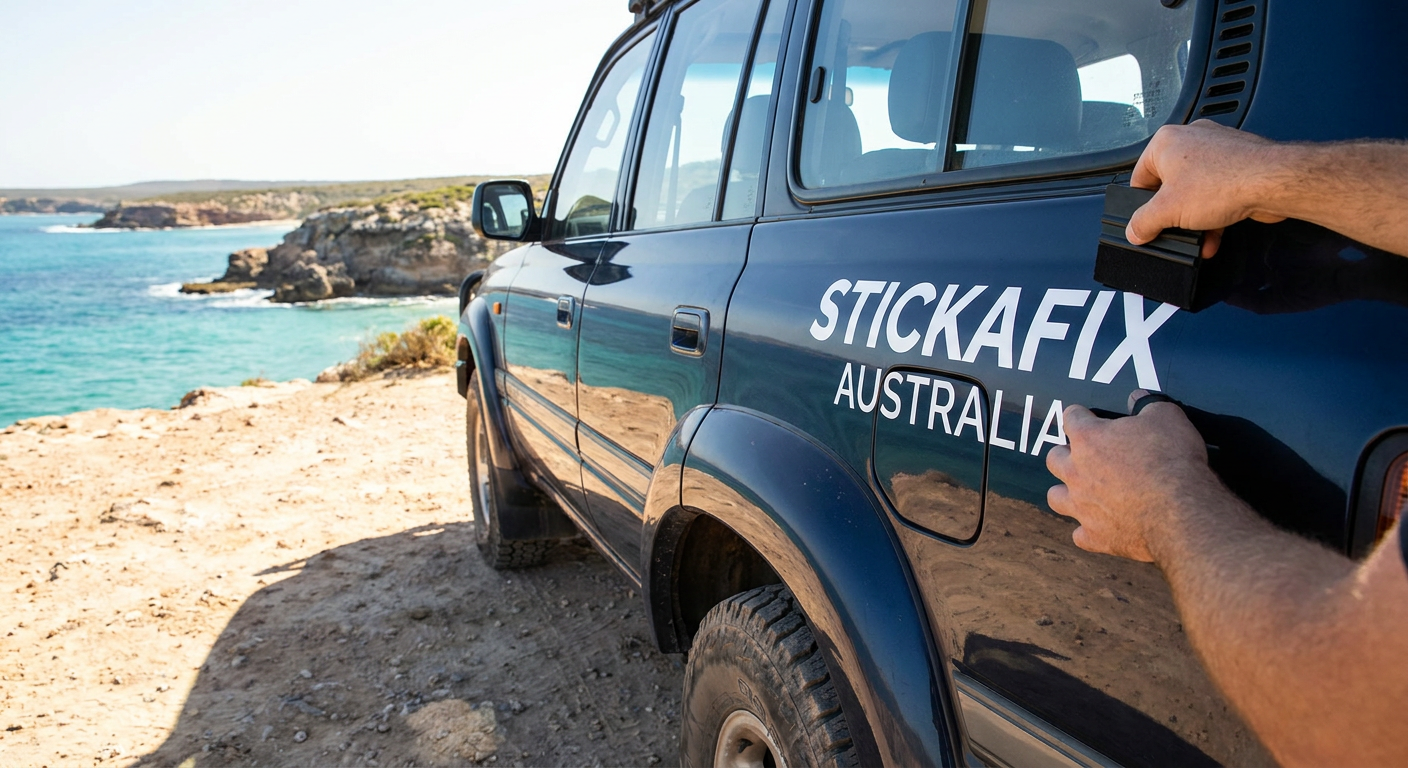
The best sticker colour is rarely the colour you like most on screen. It is the colour that still reads clearly from ten metres away, in harsh Australian midday sun, on your actual paint. That is the whole job. Vinyl sticker colours behave very differently on a black ute, a white van, a silver caravan and a gel-coat hull, and getting the contrast wrong is the fastest way to end up with lettering nobody can read.
This guide walks through how to choose car decal colours, caravan decal colours and boat sticker colours that hold up outdoors. If you want the short version of the theory first, our guide to choosing decal colours covers the fundamentals, and this article builds on it with real vehicle and vessel examples.
Contrast beats colour every time
Legibility comes from the difference in tone between the vinyl and the surface behind it, not from how bold the colour looks on its own. Squint at your vehicle in bright light. If the paint reads as dark, you need light vinyl. If it reads as light, you need dark vinyl. Mid-tone paint is the tricky one, and that is where most colour choices go wrong.
A quick test that costs nothing: take a photo of the panel on your phone, then convert it to black and white. Now imagine your chosen vinyl as a grey tone. If the two greys look similar, the sticker will vanish at distance no matter how nice the colour is. Red on dark blue is a classic offender. Both read as mid-to-dark grey and the text disappears from thirty metres.
Contrast also affects how small you can go. High contrast lettering stays readable at smaller sizes, so a white decal on black paint can be noticeably smaller than a grey one and still do its job. Before you lock in a size, run through our notes on measuring for vinyl decals so the width suits the panel as well as the viewing distance.
Dark vehicles: black, navy, charcoal and dark green
Dark paint is the easiest surface to work with. White is the default winner and for good reason. It gives maximum contrast, holds its brightness for years and photographs well for business signage or social handles.
Other strong options on dark paint:
- White for absolute clarity, especially for phone numbers, trade details and boat names.
- Yellow for high visibility vinyl on work utes and 4x4s. It carries further than white in dusty light.
- Silver or light grey for a factory-look, understated finish. Quieter and less legible at distance, so size up.
- Bright orange or lime when you want the decal to be the first thing people see.
Avoid dark reds, deep blues, browns and dark greens on dark paint. They look premium on a screen and disappear on the road.
Light vehicles: white vans, silver caravans and pale paint
White vans and silver or cream caravans are the most common vehicles in Australia and the most commonly let down by weak colour choices. On light surfaces you want depth, not brightness.
Black is the strongest performer. It is unbeatable for readability on white and it never looks dated. Dark blue, dark green, burgundy and deep purple all work well and give you brand personality without losing legibility.
Yellow, light grey and pale pastels are a poor match for white panels. Yellow in particular looks fine in the shed and turns almost invisible in direct sunlight on a white van. If you want a warm colour on white, step down to a deep orange or a rich red rather than a bright one.
Caravans add another wrinkle. Many have textured or ribbed aluminium sides, plus decorative factory stripes in mid-tones. Place your new lettering on a clean flat area away from those existing graphics if you can. Our guide to where to place vinyl decals covers panel selection, curves and rivet lines in more detail.
Mid-tone paint: red, mid-blue, silver-grey
Mid-tone vehicles need a deliberate decision, not a compromise. You have two clean paths.
Go lighter than the paint with white or cream, or go darker with black or a near-black. Both work. What fails is picking another mid-tone. Mid-blue lettering on mid-grey paint is technically two different colours and visually one blur.
Silver is its own case. It reflects surrounding light, so it can look pale in the morning and quite dark under a carport. Black lettering handles that shift better than white, because black stays black regardless of what the panel is reflecting.
Boat sticker colours and the glare problem
Water throws light upward. That means a boat decal is lit from above and below, so pale colours on pale gel coat get washed out badly on a bright day. If your hull or topsides are white or off-white, go dark. Black, navy and deep red are the reliable choices for boat names and contact details.
Dark blue hulls suit white, gold-tone or metallic silver lettering. Add a thin contrasting outline or shadow layer if you want the name to lift off the hull rather than sink into it, especially where the paint is a mid navy.
Registration lettering is a different conversation because readability is part of the requirement, not a preference. Stick to plain, high-contrast colours and simple block styles rather than scripts or gradients. Rules vary by state and territory. Confirm current size, contrast and placement with the relevant maritime authority. Stickafix supplies marine-grade vinyl lettering; final compliance depends on correct size, placement, and display on the vessel.
For names and transom lettering, the boat name designer lets you set the width and colour and shows you the layout before you order, which is far easier than guessing from a colour swatch.
Metallic, gloss and speciality finishes
Metallic vinyl reads as a mid-tone in most light, then flashes bright when the sun hits it at the right angle. That makes silver and gold metallics great for decorative boat names, caravan scripts and premium branding, and less great for critical information like a phone number that has to be readable from a moving car.
Reflective vinyl is a separate material designed to return headlight glare at night. It is worth considering for trailers, work vehicles and anything that sits on a roadside after dark, but it usually reads as a flat grey or muted colour in daylight. Colour and finish options are set in the shop and the designers, so check the available list there or get in touch through the contact page if you have a specific finish in mind.
Gloss versus matt is mostly aesthetic. Gloss pops harder and matches most factory paint. Matt suits blacked-out 4x4 builds and hides minor surface texture better, but it can look slightly softer at distance.
Which colours fade first in the Australian sun
All outdoor vinyl ages. Some colours simply show it earlier. Bright reds, oranges and some purples are the most pigment-sensitive, so they tend to shift tone before whites, blacks and blues do. North-facing and west-facing panels take the worst of the UV, and a caravan parked in the open all summer works harder than a daily-driven van that sits in a garage overnight.
German-engineered ORAFOL outdoor vinyl is built for this climate and, with reasonable care, typically lasts around five to ten years outdoors. Care matters more than people expect. Salt film, road grime and abrasive polishes shorten the life of any decal. Our notes on vinyl decal maintenance and how long vinyl decals last are worth a read if the vehicle lives outside or near the coast.
Practical takeaway: if a colour has to still look right in eight years, lean toward white, black, dark blue or dark green. If the sticker is seasonal, promotional or on something you refresh anyway, go bright and enjoy it.
Frequently asked questions
What is the best colour for car decals overall?
White on dark vehicles and black on light vehicles. Those two combinations cover the vast majority of cars, vans and utes, stay readable at distance and age the most gracefully.
Can I use two colours in one decal?
Yes, and it can look excellent, but keep the layers doing different jobs. Use one colour for the main text and the second as an outline or accent, not as an equal partner competing for attention.
Do dark decals get hotter and lift on a hot day?
Surface temperature affects application more than longevity. Apply in shade on a cool panel rather than in direct summer sun, and follow the technique in our guide on how to apply vinyl decals for a clean, bubble-free finish.
What colour works best for social handle stickers?
Match the surface, not your brand palette. A white handle on tinted rear glass or dark paint gives the cleanest read for cameras and passers-by.
Ready to pick your colour?
Choose contrast first, colour second, and size to suit the viewing distance. Get those three right and almost any palette works. When you know what you want, browse the ready-made designs in the Stickafix shop or build your own wording and colour combination in the vinyl sticker designer and see exactly how it will look before you order. Everything is cut from ORAFOL outdoor vinyl and posted Australia wide, with most orders dispatched within one to two business days.
Design your stickers
- Vinyl colour guide — The full colour, contrast and finish guide for cars, vans, boats and caravans.