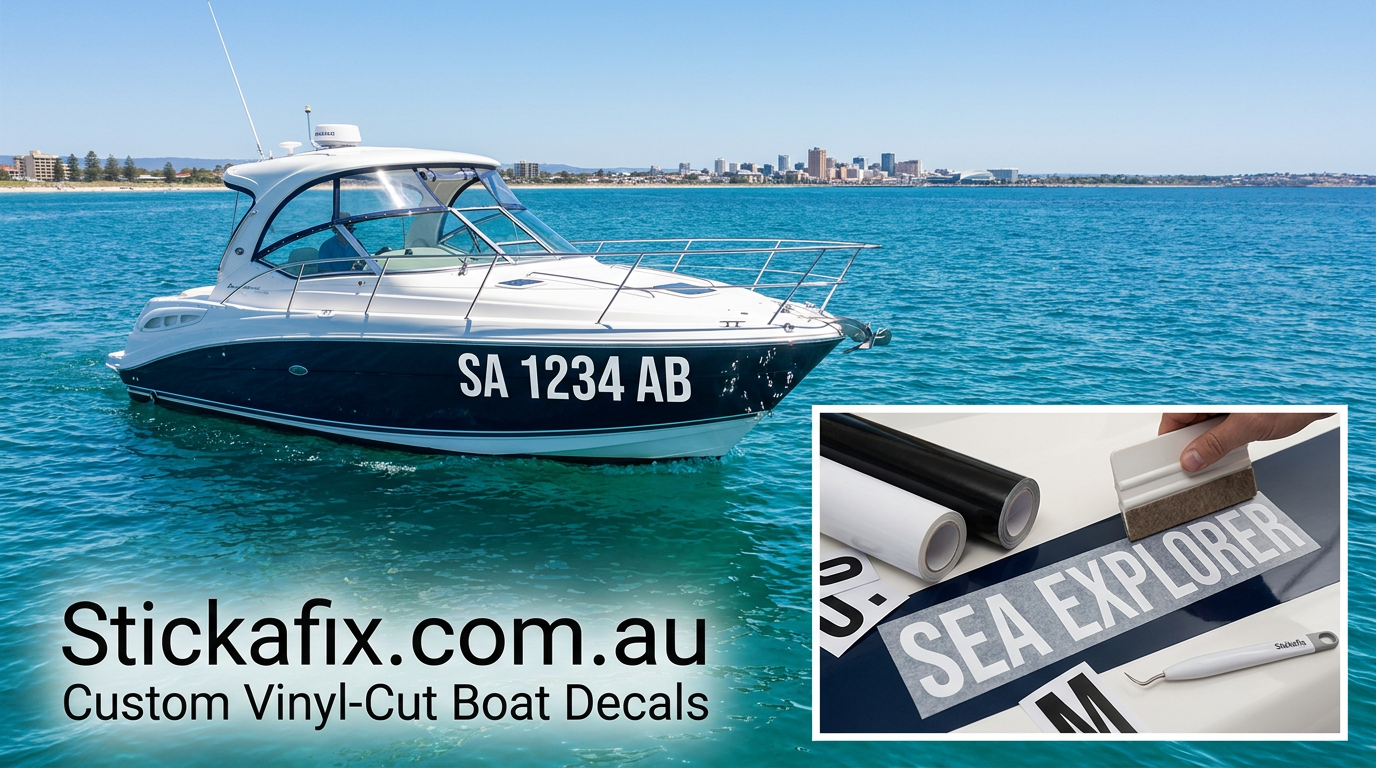
If you're chasing boat registration stickers in SA, the job is simpler than most people expect. You need registration numbers that are clearly readable on both sides of the bow, cut from vinyl that can handle South Australian sun, salt spray, and trailer travel. Cheap printed labels chalk up and curl within a season or two, which is why most South Australian boat owners end up replacing them with proper cut vinyl.
This guide covers how SA boat rego stickers work in practice, how to size and position them, which colours stay readable on different hull finishes, and how to apply them so the edges stay down. Everything Stickafix supplies is cut from German-engineered ORAFOL outdoor vinyl, the same material used for commercial vehicle graphics, so it copes with UV, washdowns, and saltwater exposure.
How boat registration numbers work in South Australia
Registered vessels in South Australia are issued a registration number, and that number needs to be displayed on the hull so it can be read from a distance. The general expectation across Australian states is the same: numbers on both sides of the bow, sitting well above the waterline, in a colour that contrasts strongly with the hull, in a plain block-style font with no decorative flourishes.
Beyond that, the detail matters and it is set by the regulator, not by the sticker supplier. Rules vary by state and territory. Confirm current size, contrast, and placement requirements with the relevant South Australian maritime authority before you order. Stickafix supplies marine-grade vinyl lettering. Final compliance depends on correct size, placement, and display on the vessel.
One thing worth separating out: your registration label (the paper or adhesive document issued with your registration paperwork) is a different item to your registration number decals. The label is issued by the regulator. The numbers on the hull are yours to supply and maintain, and that's the part we cut.
Why marine-grade vinyl matters more in SA
South Australian boating conditions are hard on adhesive. A boat launched at Wirrina, Port Vincent, or West Lakes gets salt on the hull, then sits on a trailer in full summer sun, then gets blasted with a high-pressure hose. That combination finds every weak edge.
Cast outdoor vinyl handles it differently to bargain-bin sticker stock. It stays dimensionally stable when the hull heats up, it doesn't chalk as quickly under UV, and the adhesive keeps holding when saltwater dries in the edge of the cut. With basic care, quality outdoor vinyl runs roughly 5 to 10 years, though a north-facing trailer parked in the open all summer will shorten that if it never gets rinsed. There's more detail in our guide on how long vinyl decals last.
Practical tips that make a real difference in SA:
- Rinse the hull with fresh water after saltwater use, including over the decals
- Avoid aiming a pressure washer directly at the edge of the lettering
- Skip harsh solvents and cutting compounds near the numbers
- Check the leading edge of each character after long trailer trips
Choosing colours so your numbers stay readable
Contrast is the whole point of a registration number. If a marine officer or another skipper can't read it from the water, it isn't doing its job, no matter how tidy it looks up close.
The safest combinations on Australian boats:
- White or pale gelcoat hulls: black, or a very dark navy
- Dark blue, charcoal, or black hulls: white, or a bright yellow if you want visibility over distance
- Aluminium dinghies and tinnies: black works on bright raw alloy, white works better on dark paint or wrap
- Camo or patterned wraps: pick the single colour with the most consistent contrast across the pattern, usually white or black
Avoid metallic, chrome, and gradient looks for registration numbers. They read beautifully in a photo and poorly from 50 metres in glare. If you want something with character, put it into the boat name instead and keep the rego plain. Our guide on choosing decal colours walks through hull-by-hull combinations.
Measuring the bow before you order
Most ordering mistakes come from guessing. Take five minutes with a tape measure and a roll of masking tape before you choose a size.
- Find the flattest usable panel on each side of the bow, above the waterline and clear of rubbing strakes.
- Measure the available height between the gunwale or rubbing strip and the point where the hull starts to curve away.
- Measure the available length, allowing clear space each side so the numbers don't crowd a pinstripe or hull graphic.
- Mark your intended top and bottom edges with masking tape, then step back 20 metres and look. If the height looks marginal from there, go larger.
Remember that both sides need to match, and many hulls are not perfectly symmetrical around cleats and fittings. Our guide on measuring for vinyl decals covers curved and stepped panels in more detail. Once you've got your numbers, you can set the size, colour, and spacing yourself in the boat rego designer and see the layout before you order.
Applying rego stickers without bubbles or lifting edges
Cut vinyl arrives pre-spaced on application tape, so the characters stay aligned as you fit them. The preparation is what decides how long they last.
Prep
Wash the panel with detergent, rinse, then wipe with isopropyl alcohol and let it flash off. Wax and polish residue is the number one cause of lifting edges on gelcoat, and most boats have plenty of it. If the hull has been waxed recently, clean it twice.
Temperature
Aim for a shaded panel between roughly 12 and 28 degrees. In an Adelaide summer that usually means early morning in the driveway, not mid-afternoon at the ramp. Hot gelcoat makes the adhesive grab instantly and leaves you no room to reposition.
Method
Hinge the decal with masking tape along the top, check the alignment with a tape measure from a fixed reference point, then peel the backing and squeegee from the centre outwards in firm overlapping strokes. Leave the application tape for a few minutes, then peel it back slowly at a low angle. On a curved bow, work in sections rather than trying to lay the whole run at once. The full sequence, including the wet method for larger lettering, is in our guide on how to apply vinyl decals.
Boat names, contact details, and matching sets
Plenty of SA owners order rego numbers and a boat name in the same session, since a matched pair looks far better than mismatched fonts and slightly different whites. You can set your wording and width in the boat name designer, with the height calculated to fit the text, and browse pre-made options in our boat stickers range. If your boat lives at a shared mooring or a busy marina like North Haven, a small name and mobile decal on the transom or console saves a lot of phone tag.
Frequently asked questions
Do I need stickers on both sides of the boat?
Yes. Registration numbers are displayed on both sides of the bow, and they should read the same on each side. Requirements are set by the regulator, so confirm the current rules with the relevant South Australian maritime authority.
What font should SA boat rego stickers use?
Plain block capitals. Skip scripts, outlines, shadows, and heavy italics. Legibility from a distance is the goal.
Can I put rego numbers on an inflatable or PVC tube?
Cut vinyl can be applied to clean PVC and Hypalon, but surface prep is critical and flexing tubes are less forgiving than gelcoat. Keep the numbers on a flatter, less-stressed area and clean thoroughly with isopropyl alcohol first.
How do I remove old faded numbers before fitting new ones?
Warm the vinyl gently with a heat gun or hair dryer, lift a corner, and pull back at a low angle. Adhesive residue comes off with a purpose-made remover and a soft cloth. Our guide on removing old vinyl decals covers gelcoat safely.
How long does delivery take in South Australia?
Most orders dispatch within 1 to 2 business days, with standard Australia Post delivery typically taking 3 to 7 business days. Express may be available at checkout.
Ready to sort your numbers
Registration numbers are one of the few jobs on a boat where doing it properly costs very little more than doing it badly. Measure your bow, pick a high-contrast colour, prep the panel, and use vinyl built for salt and UV rather than a printed label that will chalk out by next season.
When you're ready, set your numbers up in the boat rego designer and add a matching name if you want the full set. If you're unsure about sizing for an unusual hull, send us your measurements through the contact page and we'll talk it through before you order. Rules vary by state and territory, so confirm current size, contrast, and placement with the relevant maritime authority. Stickafix supplies the marine-grade vinyl lettering; correct size, placement, and display on the vessel are up to you.
Design your stickers
- Registration numbers for Australian boats — Design boat registration stickers online in marine-grade vinyl.