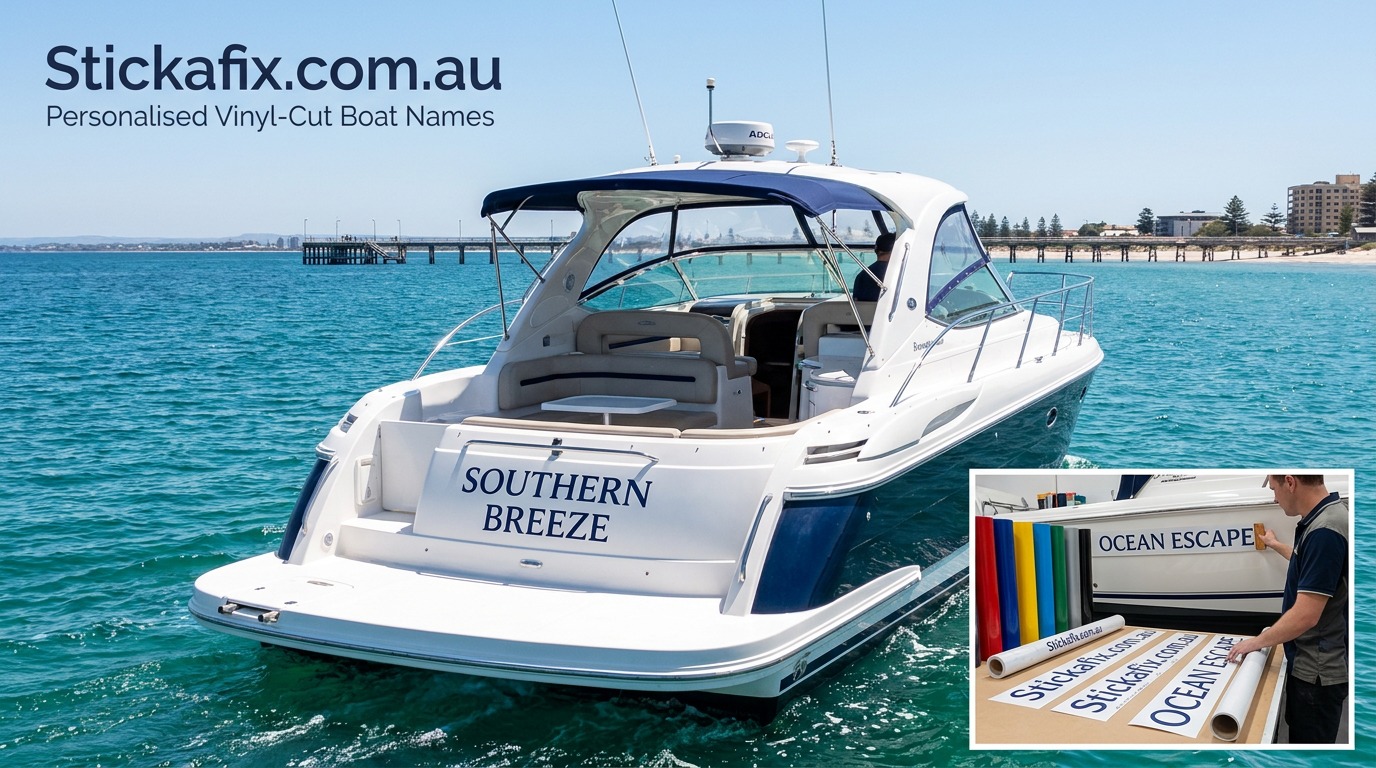
If you're after custom boat name stickers in South Australia, the job is simpler than most owners expect. You pick your wording, choose a width, choose a colour, and apply the lettering yourself in under an hour. The difference between a name that still looks sharp in five years and one that chalks off in two summers comes down to the vinyl, the colour contrast, and how carefully you prep the hull before the transfer tape touches gelcoat.
South Australian boating is hard on decals. Gulf St Vincent and Spencer Gulf mean constant salt spray, Adelaide summers push surface temperatures on a dark hull well past what the air temperature suggests, and trailer boats spend most of the year baking in a driveway or under a carport. That's why every name we cut uses German-engineered ORAFOL outdoor vinyl, the same material used across our marine and boat stickers range.
Why vinyl lettering beats painted boat names in SA conditions
Painted names look great on day one, but they crack and lift along the edges as the hull flexes and the paint ages. Vinyl moves with the surface. Cut vinyl lettering also lets you change a name without sanding, filling, and respraying, which matters if you buy a second-hand runabout with someone else's name on the transom.
With reasonable care, ORAFOL outdoor vinyl holds up for roughly 5 to 10 years. In South Australia the north-facing side of a hull, or a transom that sits square to the afternoon sun at a Port Adelaide berth, will always fade first. A quick rinse after each trip and an occasional wipe with a mild boat wash does more for decal life than any product you can buy.
What you get with vinyl-cut names
- No background square. Each letter is cut individually, so only the letters sit on the hull.
- Pre-spaced on application tape, so the whole name goes on as one piece.
- Solid colour right through the film, so scratches don't show a white core.
- Removable later with heat and patience, without wrecking the gelcoat.
Choosing a size that suits your hull
Most trailer boats between 4 and 6 metres suit a name somewhere in the 400mm to 700mm width range on each side of the hull or across the transom. Larger cruisers and yachts moored at North Haven or Wirrina often carry names 900mm and wider. In our boat name designer you choose the overall width and the height is calculated to fit the text, so longer names stay in proportion instead of becoming unreadably thin.
The measuring part matters more than the maths. Work out the flattest, cleanest run of hull you have, then leave a margin at each end so the name doesn't crowd a rubbing strake, a bunk rub mark, or a transom drain. Masking tape is your friend here: run a strip where you want the top of the letters and stand back on the trailer ramp to check it looks level from a distance. Our guide to measuring for vinyl decals walks through the process with a tape measure and a few minutes of patience.
Script fonts versus block fonts
Script and italic styles look brilliant on a white fibreglass yacht, but thin connecting strokes need a bit more height to survive the weather and stay legible from the water. Bold block fonts read better at distance and handle a textured or riveted surface far more forgivingly. If your boat is an alloy tinny with a slightly dimpled side, go bolder.
Fibreglass boats versus aluminium boats
Gelcoat is the easiest surface in the world for vinyl. Wash it, dry it, wipe with isopropyl alcohol, and the lettering bonds beautifully. Avoid applying over fresh polish or wax residue, which is the single most common cause of letters lifting at the corners a week later.
Painted aluminium behaves much like gelcoat. Bare or raw alloy is different: the mill finish can be slightly textured and often carries an oxide layer, so a firm squeegee pass and extra pressure on the edges is essential. Skip the wet method on bare alloy and apply dry, then work each letter down from the centre outwards. Riveted side panels are fine as long as you position the name on a flat run between rivet lines wherever possible.
Pontoons, inflatable tubes, and flexible PVC are the exception. Standard outdoor vinyl is not designed for those surfaces, so keep your name on the rigid hull or transom.
Colour choices that actually read on the water
Contrast is everything. White hulls are the most common in South Australia, and dark colours read best on them: black, navy blue, dark red, bottle green. On a blue or dark grey hull, white and gold are the safest bets, with silver a close third if your fittings are stainless.
Two practical tips. First, metallic and gloss finishes look excellent in the marina but can flare in the harsh afternoon glare at Glenelg or Wallaroo, so a solid matte or standard gloss is often more legible from a distance. Second, red pigments historically fade faster than dark blues and blacks under strong UV, so consider that if your boat lives outdoors year round. Our guide to choosing decal colours covers hull and background combinations in more detail.
Applying your boat name in about 30 minutes
Pick a calm, shaded morning with a surface temperature somewhere between roughly 10 and 30 degrees. Adelaide afternoons in January will cook the adhesive before you get the tape flat, and a cold winter morning at the shed slows the initial tack.
- Wash the area with detergent, rinse, and dry completely.
- Wipe with isopropyl alcohol and let it flash off.
- Tape the name in position with a hinge of masking tape along the top edge.
- Step back and check the level from several metres away, then adjust.
- Peel the backing paper away under the hinge and squeegee from the centre out.
- Remove the application tape slowly at a shallow angle, pulling back on itself.
- Press down any lifting edges with a thumb through a soft cloth.
Leave the boat out of the water for 24 hours if you can, and avoid a high-pressure washdown directly at the letter edges for the first week. Full step-by-step detail, including the wet method and bubble fixes, is in our how to apply vinyl decals guide.
Matching your name with registration numbers
Plenty of South Australian owners order a name and registration lettering together so the font and colour match across the hull. You can design marine registration numbers in the same vinyl with our boat rego designer, or the jetski and PWC registration designer if you also run a ski.
Rules vary by state and territory. Confirm current size, contrast, and placement with the relevant maritime authority. Stickafix supplies marine-grade vinyl lettering; final compliance depends on correct size, placement, and display on the vessel.
Frequently asked questions
Are boat name stickers waterproof?
Yes. Cut vinyl lettering is fully waterproof once applied and cured, and it's rated for continuous outdoor and saltwater exposure. Trailering at highway speed and regular washdowns are no problem once the adhesive has had a day to set.
How long does delivery take to South Australia?
Most orders dispatch within 1 to 2 business days, with standard Australia Post delivery typically taking 3 to 7 business days to metropolitan Adelaide and regional SA. Express may be available at checkout.
Can I remove the old name from a second-hand boat?
Usually yes. Warm the old lettering gently with a heat gun or hair dryer, lift a corner, and peel slowly. Adhesive residue comes off with a citrus-based remover and a microfibre cloth. Test any solvent on a hidden patch of gelcoat first.
Will the letters fit a curved hull?
Individual cut letters handle gentle curves well because each one conforms separately. Very tight compound curves are harder, so choose the flattest section of the hull for long names.
Order your custom boat name
Whether your boat sits on a trailer in the Adelaide Hills, on a mooring at Glenelg, or on the Murray for the summer, a clean vinyl name finishes the whole vessel off. Choose your wording, width, and colour in the boat name designer, or browse ready-made options in the Stickafix shop if you need additional marine decals at the same time.
Design your stickers
- Custom boat name lettering — Design vinyl-cut boat name stickers and pair them with matching registration numbers.
- Registration numbers for Australian boats — Cut vinyl boat rego stickers — contrast colours, pairs, and sizes for hulls.