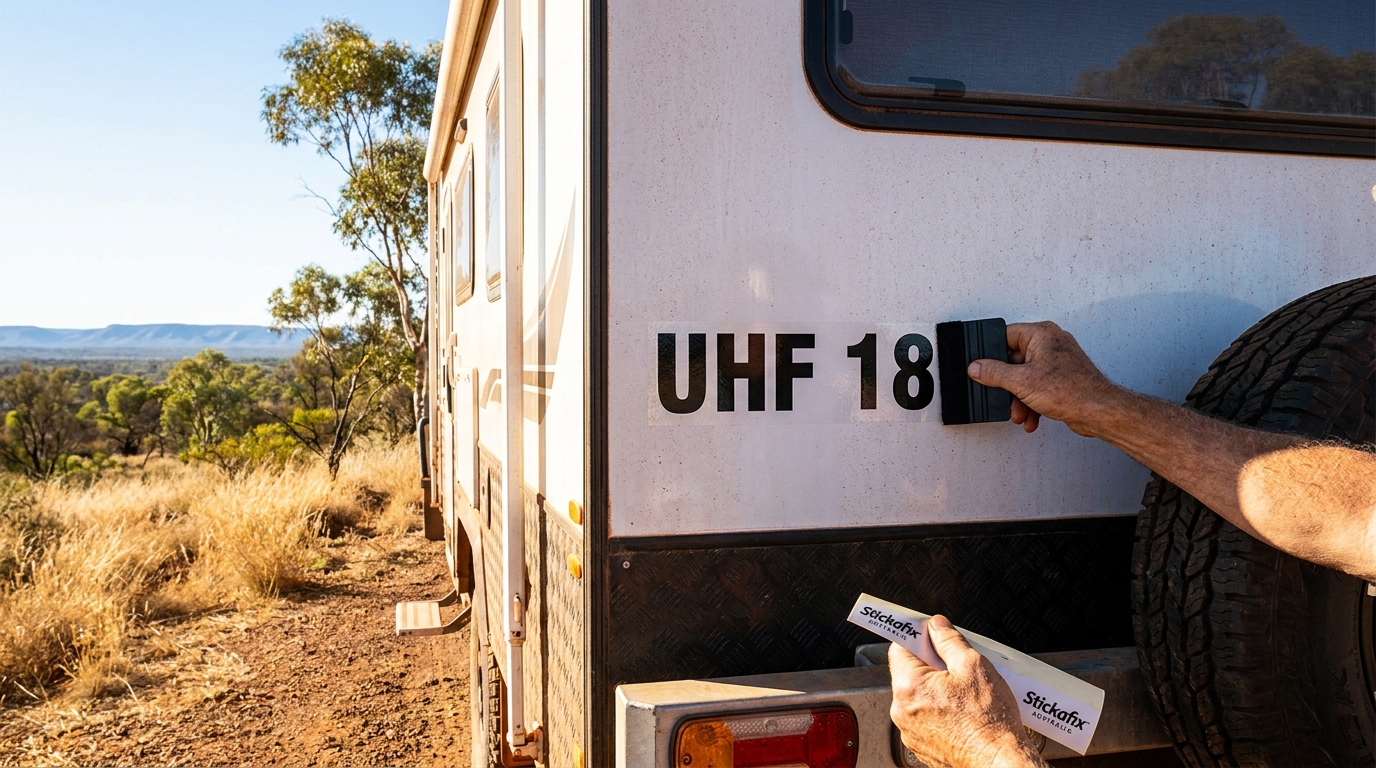
If you've ever sat behind a caravan on a single-lane climb wondering whether the driver was monitoring channel 18 or 40, you already understand why UHF channel stickers are so popular with Australian tourers. A simple decal on the back of your van, camper or 4WD tells everyone behind you exactly which channel you're listening on — no guessing, no cycling through 80 channels, no missed calls when someone wants to overtake.
This guide covers the standard Australian UHF channel conventions, how to choose the right channel for your setup, where to place your sticker and what size to order so it's actually readable on the road.
Why UHF Channel Stickers Are Worth Having
UHF CB radio is still the backbone of communication for touring Australia. It's free to use, doesn't need mobile coverage, and works just as well on the Oodnadatta Track as it does on the Bruce Highway. The problem is that with 80 channels available, two vehicles can be 50 metres apart and never hear each other.
A UHF channel decal solves that in a single glance. The practical benefits stack up quickly:
- Safer overtaking. Trucks, other tourers and grey nomads can call you to arrange a pass on a narrow highway instead of sitting on your bumper.
- Convoy coordination. Groups heading up the Cape, across the Simmo or along the High Country can spot each other's channel instantly at a fuel stop.
- Road hazard warnings. Livestock on the road, wide loads, washouts, flooded causeways and oncoming traffic on blind corners are all easier to pass on when people know how to reach you.
- Recovery and track etiquette. On popular 4WD tracks, knowing the channel means you can announce your position before an awkward pass on a steep ledge.
- Friendly contact. Plenty of travellers have made mates on the road purely because someone read their channel sticker and called up for a chat.
Australian UHF Channel Guide (80-Channel Radios)
Australia's UHF CB band runs across 80 channels. Some are governed by regulation, and others are simply long-standing convention that most road users respect. Here's the rundown:
Channels You Should Never Use for General Chat
- Channel 5 and 35 — emergency calls only. Channel 5 is the recognised emergency channel and 35 is its duplex partner. Keep them clear.
- Channels 22 and 23 — data and telemetry only. No voice transmissions permitted.
- Channels 31–38 and 71–78 — repeater inputs. Avoid using these for simplex chat, as you'll be transmitting into repeaters and interfering with other users.
- Channels 61, 62 and 63 — reserved. Leave them alone.
The Channels Most Tourers Care About
- Channel 10 — 4WD clubs, convoys and national park travel. The default choice for off-road groups.
- Channel 11 — the call channel. Use it to make contact, then move to a free channel for a longer conversation.
- Channel 18 — the caravan and campers convention channel. If you're towing a van, this is the one most other vanners will look for.
- Channel 29 — road safety channel traditionally used on the Pacific Highway in NSW.
- Channel 40 — the main highway and truckies channel across Australia. Great for road condition updates and overtaking calls.
- Channels 1–8 and 41–48 — repeater outputs (duplex), used to extend range in remote and hilly country.
- General simplex chat — channels 9, 12–17, 19–21, 24–28, 30, 39, 49–60, 64–70, 79 and 80 are all fair game for everyday use, club nets and family convoys.
Which Channel Should You Put on Your Sticker?
Keep it simple and match the convention for your style of travel. If you tow a caravan or camper trailer, channel 18 is the safest bet — it's what other vanners and most truckies will expect. If your rig is primarily a touring 4WD that spends time on tracks and in convoys, channel 10 makes more sense. Plenty of highway travellers also run channel 40, particularly on long hauls where truck traffic is heavy.
Some travellers order two UHF channel number stickers — for example, 18 on the rear of the van and 40 on the tow vehicle's rear bar — or a dual decal reading something like "UHF 18 / 40". If you scan multiple channels, a sticker that says "UHF CH 18" plus "SCANNING 40" is clear and honest. What matters is that the channel on your sticker is one you actually monitor with the volume up.
Where to Place Your UHF Sticker
The golden rule: put it where a driver behind you can read it without craning their neck. Good options include:
- Rear of the caravan or camper — high on the back wall, above the bumper and clear of the spare wheel, bike rack and jockey wheel. Aim for roughly eye height for a following driver.
- Rear window or tailgate of a 4WD, ute or wagon.
- Spare wheel cover — a classic spot on Prados, Patrols and 4WD campers. Flat, flexible vinyl works well here.
- Rear bar or wheel carrier — smooth, painted surfaces only.
- Jerry can holders, toolboxes and canopy doors for secondary placement.
- Bullbar or front doors if you want oncoming traffic and other convoy vehicles to see it too.
Avoid placing decals over deep ribs, rivet lines, textured checkerplate, or aluminium seams — vinyl needs a smooth, flat surface to bond properly. Also keep clear of number plates, brake lights and indicators.
Choosing a Size That's Actually Easy to Read
This is where most people get it wrong and order something too small. A sticker that looks big on your kitchen table can be unreadable from three car lengths back at 100 km/h. Use these rough guides for digit height (the number itself, not the whole decal):
- 50–75 mm digits — readable at around 10 metres. Fine for camp ground and convoy use, or for a second sticker on a toolbox or door.
- 100–150 mm digits — readable at 20–30 metres. The sweet spot for most 4WD rear windows, spare wheel covers and tailgates.
- 200–300 mm digits — readable at 50 metres or more. Ideal for the back of a large caravan, fifth wheeler or motorhome where you want highway traffic to read it from a distance.
A handy test: print your chosen size on paper, tape it to the back of your van, walk 30 metres away and see if you can read it. If you squint, go bigger.
Contrast matters just as much as size. Dark digits on a white or light surface, or white digits on a dark van, read best. Bold, block-style fonts beat script every time. If you do a lot of dawn and dusk driving, consider a reflective vinyl so your channel lights up in headlights.
Vinyl Quality and Australian Conditions
Australian sun destroys cheap stickers. A decal on the back of a van copes with UV, dust storms, corrugations, gravel rash, coastal salt spray and repeated pressure washing. Look for outdoor-rated cast or premium calendered vinyl with a UV-stable finish, and cut vinyl lettering or a laminated printed decal rather than paper-based prints.
At Stickafix we produce custom UHF stickers for 4WD and UHF stickers for caravan use in durable outdoor vinyl, so your channel number stays crisp and legible for years rather than fading to a ghost after one summer.
How to Apply Your UHF Channel Decal
- Clean the surface thoroughly with warm soapy water, then wipe with isopropyl alcohol to remove wax, polish and road film.
- Let the surface dry completely and work in the shade, ideally between 10°C and 30°C.
- Use masking tape to hinge the decal in place and check alignment from a few metres back before committing.
- Peel the backing away and squeegee firmly from the centre outwards to push out air.
- Slowly remove the transfer tape at a low angle. If lettering lifts, lay it back down, squeegee again and try once more.
- Leave it 24–48 hours before high-pressure washing.
Quick Tips for Getting the Most From Your UHF
A sticker only works if the radio does. Make sure your antenna is mounted clear of the vehicle body with a good earth, keep the squelch low enough to hear distant calls, and actually monitor the channel you've advertised. When calling another vehicle, describe them rather than guessing their name — "white Landcruiser towing the black van, southbound on the Newell" gets a response every time.
Also remember that channel conventions differ slightly by region and club, so it pays to ask locally when you roll into a new area. But a clear, correctly sized UHF channel sticker on the back of your rig makes you easy to reach wherever you travel — and that's what safe, sociable touring is all about.
Order Your Custom UHF Channel Stickers
Whether you need a single 18 for the back of the van, a matching pair of 10s for a club convoy or a set of large reflective digits for a motorhome, Stickafix can cut UHF radio stickers to your chosen channel, size and colour. Pick a size that reads from 30 metres, stick it where following traffic can see it, and enjoy a quieter, safer run down the highway.